



JIS K 7317:2022 is a Japanese Industrial Standard that specifies how to determine the scratch hardness of plastic functional films. Established in 2022, it provides a highly reproducible surface-hardness evaluation method for the functional-film industry—covering optical films, hard coats, display films, and more. This article explains the standard overview, test method, and key points for selecting the right testing equipment.
👉 For JIS K 7317:2022 testing: Steel Wool Durability Tester TYPE:38F (dedicated instrument compliant with the standard)
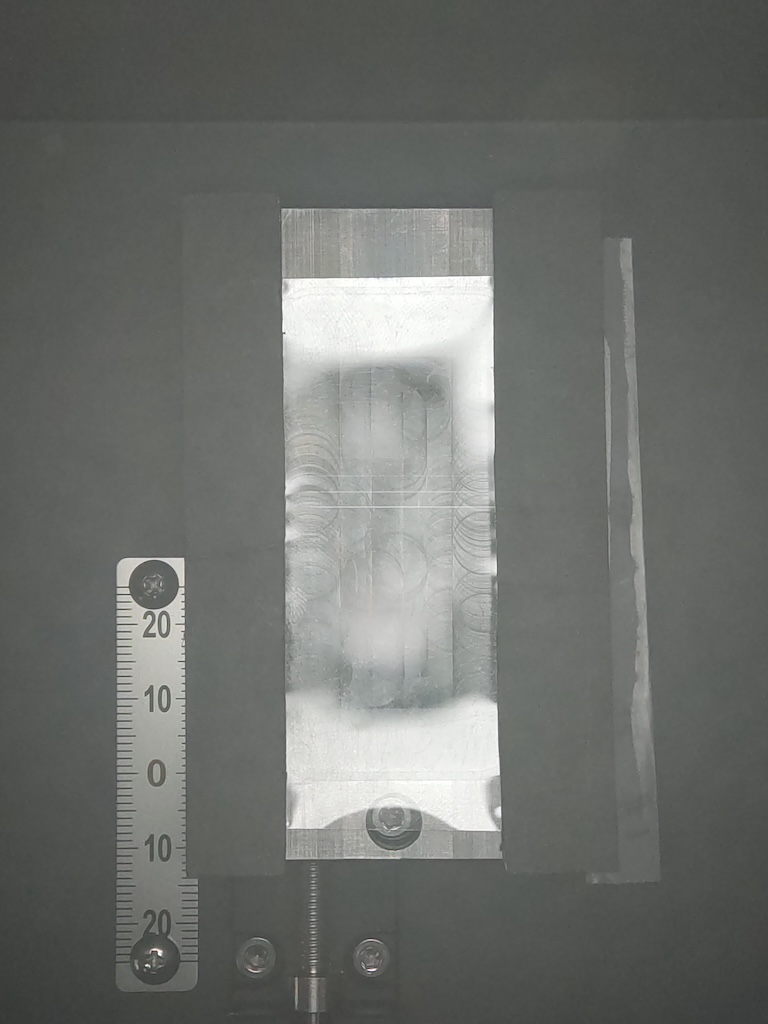
What is JIS K 7317:2022?
JIS K 7317:2022, formally titled “Plastics — Determination of scratch hardness of specialty films,” is a Japanese Industrial Standard established in 2022.
Traditionally, JIS K 5600-5-4 “Testing methods for paints — Scratch hardness (pencil method)” was adapted for evaluating the surface hardness of functional films. However, because it was originally designed for paint-film evaluation, using it for functional films presents the following problems:
- The pencil tip changes shape during testing, making reproducibility difficult to achieve
- Visual assessment introduces variability
- Insufficient quantitative precision and reproducibility as a commercial acceptance criterion
Against this background, at the request of the functional-film industry, JIS K 7317:2022 was established as a more quantitative and reproducible test method.
What are Functional Films?
Functional films are plastic films to which specific properties (optical, electrical, protective, etc.) have been imparted. Representative applications include:
- Hard-coat films for displays
- Optical films (polarizers, anti-reflection films, etc.)
- Battery separator films
- Barrier films for packaging
- Films for solar cells
These films are used across a broad range of industries—electronics, automotive, displays, packaging, medical, and aerospace—and surface scratch resistance and hardness are directly linked to product quality. Japanese manufacturers hold a large share of the global market in this sector, making a standardized test method essential for quality assurance.
Test Method of JIS K 7317:2022
JIS K 7317:2022 uses a diamond indenter to perform a scratch test, and evaluates the result by determining the maximum load at which no visible scratch appears. The equipment configuration and conditions are specified as follows.
① Indenter
The indenter material shall be diamond, which is resistant to deformation and highly durable, with a tip sphere radius of 0.10 mm ± 0.01 mm. During the standardization process, multiple sphere radii were compared, yielding the following findings:
- 0.05 mm: Force concentrates at the tip, producing visible scratches at low loads — unsuitable for soft materials
- 0.5 mm / 1.0 mm: Stress is distributed, making scratches harder to see and introducing result variability
- 0.2 mm: Larger contact area than 0.1 mm leads to stress distribution and greater variability
Based on these evaluations, 0.10 mm ± 0.01 mm was adopted as the optimal value.
② Test Speed
Test speed is specified as 1.5 mm/s to 2.0 mm/s. When the speed is too slow, scratches form more easily, affecting the result. Verification during standardization confirmed no significant difference in scratch hardness over the 1.5–2.0 mm/s range, and this range was adopted to maintain compatibility with the existing JIS K 5600-5-4 pencil method (0.5–1.0 mm/s).
③ Visual Assessment Method
JIS K 7317:2022 defines a scratch as “a change in reflected light caused by refraction and scattering at the scratched area when reflected light is directed onto the specimen.” The following assessment methods are recognized:
- Visual assessment under normal room lighting (fluorescent or LED)
- Visual assessment using a darkened observation box
- Use of a visual assessment jig (coaxial incident-reflected optical system with a half-mirror)
- Use of an optical surface inspection system (defect detector) for films
All methods share the same principle: detecting changes in reflected light due to refraction and scattering. Verification confirmed no significant difference in assessment results between methods.
Comparison: JIS K 7317:2022 vs. Pencil Method (JIS K 5600-5-4)
| JIS K 7317:2022 | JIS K 5600-5-4 (Pencil method) | |
|---|---|---|
| Primary target | Plastic functional films | Paint films and coatings |
| Indenter | Diamond, sphere radius 0.10 mm ± 0.01 mm | Pencil (HB, H, 2H, etc.) |
| Test speed | 1.5–2.0 mm/s | 0.5–1.0 mm/s |
| Evaluation criterion | Maximum load [g] at which no scratch appears | Pencil hardness (HB, H, etc.) |
| Reproducibility | High — indenter shape does not change | Variable — pencil tip wears during testing |
JIS K 5600-5-4 (pencil method) remains valid as a test method for paint coatings, but JIS K 7317:2022 is the new standard for evaluating functional films.
Key Equipment Selection Point: Axis Sensitivity
When selecting a tester for JIS K 7317:2022 compliance, the most critical factor is axis sensitivity (load responsiveness) in the low-load range.
Because JIS K 7317:2022 testing begins at loads as low as 10 g, the axis sensitivity of the tester has a major impact on results. A tester with insufficient axis sensitivity cannot correctly transmit 10 g load increments to the specimen, introducing errors in the assessment.
A particular concern is using a tester designed for pencil hardness testing (JIS K 5600-5-4). Pencil hardness testers are designed for loads in the hundreds-of-grams range, so they may not provide the axis sensitivity needed to resolve 10 g load differences. If such a tester is used for JIS K 7317:2022, insufficient precision in the low-load range may prevent detection of differences that should be measurable.
HEIDON testers are designed to ensure high axis sensitivity in the low-load range, accurately reproducing the 10 g load increments required by JIS K 7317:2022.
HEIDON Models Compatible with JIS K 7317:2022
HEIDON offers multiple models compatible with JIS K 7317:2022, including a dedicated instrument.
Dedicated Model: Steel Wool Durability Tester TYPE:38F
Designed specifically for JIS K 7317:2022 testing. Equipped with the specified diamond indenter (sphere radius 0.10 mm ± 0.01 mm), the specified test speed (1.5–2.0 mm/s), and high axis sensitivity in the low-load range.
Other Compatible Models
The following models can also support JIS K 7317:2022 testing with appropriate fixture and indenter selection.
Please contact us to confirm whether your current Tribogear model is compatible.
- Surface Property Tester TYPE:14FW
- Friction and Wear Tester TYPE:40
- Friction and Wear Tester TYPE:38
- Load-variable Friction and Wear Test System HHS2000S/HHS3000S
Related Products
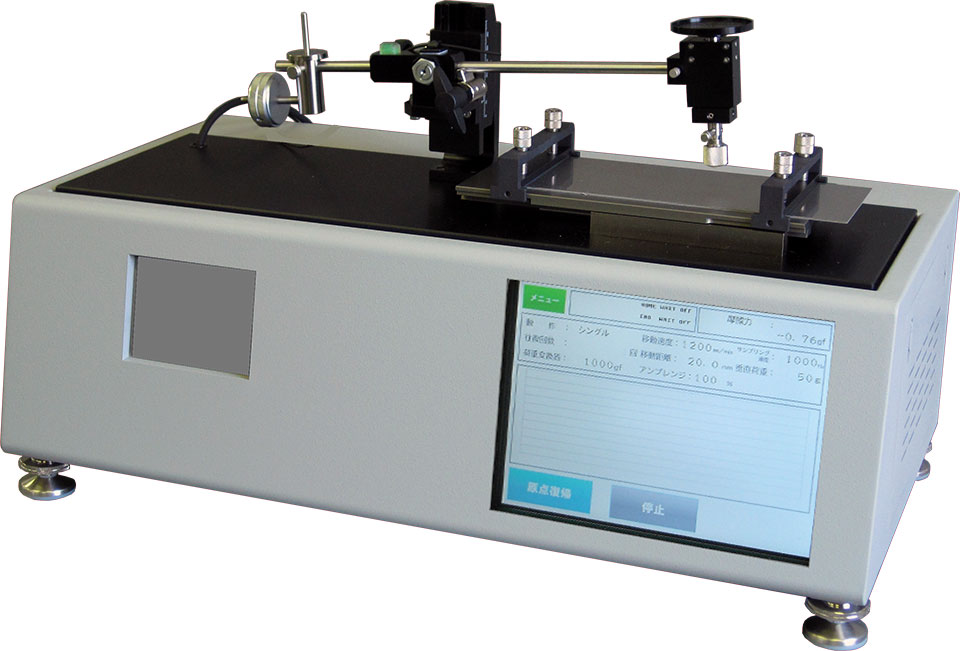
Steel Wool Durability Tester TYPE:38F
Dedicated tester for JIS K 7317:2022
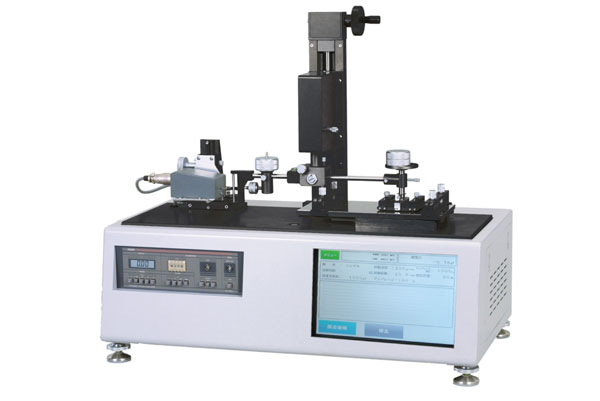
Surface Property Tester TYPE:14FW
General-purpose surface evaluation tester. Compatible with fixture change.
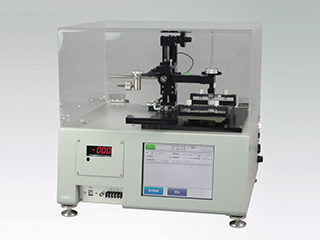
Friction and Wear Tester TYPE:40
Versatile friction and wear tester. Compatible with fixture change.
Inquiries about JIS K 7317:2022 Testing
For questions about model selection, test conditions, or commissioned testing related to JIS K 7317:2022, please feel free to contact HEIDON.