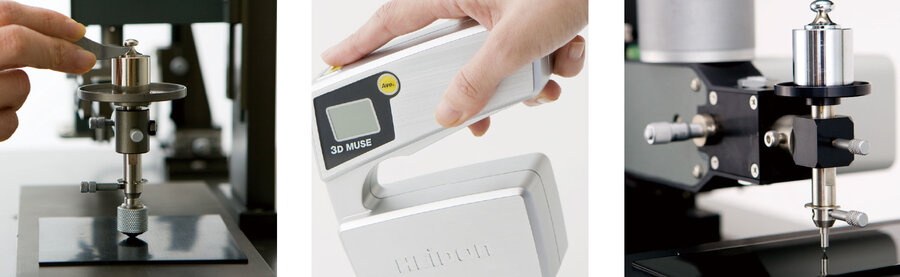

The scratch test is one method for measuring the hardness of a material’s surface.
>> Contact us for friction and wear testing inquiries
What is a Scratch Test?
A scratch test is a method for evaluating a material’s surface strength and scratch resistance by scratching the surface, then observing the depth and shape of the resulting marks.
In a scratch test, a hard stylus made of diamond or sapphire is drawn across the specimen surface under a defined load.

Test Process
First, the specimen is fixed in place and a hard stylus is drawn across the surface under constant pressure. The stylus material, shape, and applied load all affect the test result.
For example, to evaluate the scratch resistance of the glass used in a smartphone screen, a diamond stylus is used to scratch the surface with a defined force.

Evaluating the Test Results
A microscope is used to examine the depth and shape of the scratch marks in detail. This makes it possible to quantify what kind of scratch was produced at a given load, enabling objective evaluation of surface strength and scratch resistance.
Advantages and Disadvantages
Advantage: Surface properties can be evaluated quickly and easily. The test can be completed in a short time, and it is well suited for comparing different materials or surface treatments.
Disadvantage: Results are highly sensitive to the specimen type and surface condition. For example, differences in surface smoothness or cleanliness of the same material can produce different results. Careful attention to sample preparation and test conditions is therefore essential.
When is a Scratch Test Needed?
Scratch testing is an important test conducted in many situations, including:
- Product quality control
- Materials research
- Standards compliance
Product Quality Control
Scratch testing is widely used to manage product quality. For products that consumers handle daily—such as smartphone screen protectors and automotive paint coatings—surface scratch susceptibility is a critical concern. Scratch testing allows manufacturers to assess surface strength and confirm durability.
Materials Research
In materials research and development, scratch testing plays an important role in evaluating the performance of new coating materials and surface treatment technologies. For instance, in the development of anti-fouling coatings, scratch tests confirm the durability of the coating. Based on the results, researchers can refine their understanding of the material and develop improved products.
Standards Compliance
In many industries, scratch testing is required to demonstrate that products meet specific standards. For example, ISO 12137-2:1997 and JIS K 5600 recommend scratch testing to evaluate the scratch susceptibility of paints and varnishes. Compliance with these standards demonstrates that a product meets defined quality benchmarks, providing reliability to consumers and clients.
Friction and Wear Testers for Scratch Testing
Performing a scratch test requires dedicated friction and wear testing equipment designed to scratch the material surface under a controlled load and evaluate the resulting marks. High-performance equipment is essential for ensuring reproducibility and reliability of test results.
Continuous-Load Scratch Strength Tester TYPE:18/18L
TYPE:18/18L quantifies scratch susceptibility using a continuous load. Key features:
- Wide range and high reproducibility: Selectable continuous loads of 0–50 g, 0–100 g, and 0–200 g allow testing over a broad load range. By placing a 100 g constant-load weight and combining it with the 0–200 g continuous weight, loads of 100–300 g can also be achieved. The mechanical design requires no special calibration, ensuring highly reproducible results.
- Dedicated data analysis software: Using the “Tribosoft” software, the resistance force on the stylus during scratching can be recorded for detailed evaluation, quantifying the surface fracture strength and scratch hardness of the material. (TYPE:18L only)
Continuous-Load Scratch Strength Tester TYPE:18/18L
Contact HEIDON — Over 70 Years of Friction & Wear Expertise
HEIDON has been a leading friction and wear testing specialist since 1952. For customers who find purchasing a tester challenging, we also offer commissioned testing services.
⇒Commissioned Testing by a Friction & Wear Testing Specialist
Related Products

Static Friction Coefficient Tester TYPE:10
Standard instrument for measuring static friction coefficient by the incline method

Portable Friction Meter TYPE:94i-II
Measure kinetic friction coefficient on-site instantly

3D Muse TYPE:37i
High-functionality portable friction meter with 3-axis measurement
Inquiries about Friction and Wear Testing
For test condition selection, equipment selection, or commissioned testing, please feel free to contact HEIDON.